Monday, October 3, 2011

Museum of Contemporary Art, Jacksonville


FILM/LECTURE:

Dirty Pictures: Controversy and Photography

Saturday, Oct. 8, 2 p.m.
See a screening of Dirty Pictures, a retelling of the 1990 attempts to censor the Cincinnati Contemporary Arts Center’s controversial Robert Mapplethorpe photography exhibit. Afterwards, MOCA Director Marcelle Polednik will discuss and answer questions about controversy and broader issues facing photography such as: Who gets to decide what forms of expression are valid? Does the constitutional right to freedom of expression apply to forms of expression you don’t like?
Free
Link here for more films/lectures/exhibitions.  Link also has map and museum hours.

Reaction Packet #1, Lightner Musuem

Field Trip to Lightner Museum

Homework, Part I - Collect at least ten (10) images that would appear in your museum.  Go global - search the world for object and images.

Homework, Part II - Create a brochure for your museum.  Refer to the original ten (10) images that you found for Part I of this homework.  You can handwrite, collage, type and/or use the computer to create the brochure. There is no format or size limit requirement.  Can be color or black/white.

Important! Use these terms in your brochure - ICON and SYMBOL.  Reference each term at least once.  Your brochure should demonstrate time and effort.  The brochure should also have content.  Information pertaining to the objects in your museum should be factual.  Other information such as the name of your museum, location, hours, etc.... will be invented.  Check out on-line museum information to help you design and write your brochure.

Hand in a hard copy of the brochure to me.  Due Wednesday, October 5.  Also hand in the original ten (10) images you found for Part I of this homework assignment.

Check list for musuem brochure:
-First task - look at museum pages on-line to get a feel for how to present and organize your information.
-Invent a name, location and hours of operation for your Museum.
-Include a description of your museum.  Include history of museum (who founded, when, why, how).
-Include at least four images should appear in your museum brochure.
-You should reference the terms ICON and SYMBOL (each one at least once) in your brochure.
-Feel free to add additional information to your brochure.  Suggestions: A current exhibition, upcoming exhibitions, artist talks and/or any awards/grants/recognition your museum may have received.

NOTE: Evaluation criteria based on including the information listed above and providing evidence of thoughtful, insightful and innovative content.

Friday, September 23, 2011

Wednesday, September 21, 2011

Semiotics - Icons and Symbols

Semiotics is the study of signs and symbols and their use or interpretation.  Early 1900's, Swiss linguist Ferdinand de Saussure (1857-1913).  American philosopher Charles Sanders Peirce (pronounced 'purse') (1839-1914).


Icon - A representation of the object itself, keeping its characteristics.  Resembles something.  Can be illustrative, diagrammatic, a photograph or the object/person itself.

People as icons - an image or name, an individual reduced to an idea.

Discuss - Celebrity is the state of being well known.  How does one obtain celebrity status?  In our culture?  Other cultures?  Past cultures?  Do celebrities fuel our/a culture?  How?  Why?


Link here for images and brief bio of Iconic People.


Symbols - No logical meaning for what it stands for. Have no resemblance to the real object, it’s a result of a convention (considered acceptable to most members of a society). A dove represents peace, but there’s no connection between the animal and peace, it’s just a convention. 

A symbol (an image or text) can only make meaning if the person already knows the convention - a matter of culture and previous knowledge.  For each culture the symbol makes meaning.
Color in cultures.  


Further Reading:
Signs and Language.  Link here.
The Age of the Female Icon by Holly Brubach, New York Times Magazine. Link here.
Perceptions of Female Beauty in the 20th Century by Louise Wood. Link here.

Tuesday, September 20, 2011

Terms and People for Test #1

Terms and People for Test #1. Test #1, Monday, Oct. 3. Final list of people and terms posted at 10:00 pm on Sunday, Oct. 2

Culture
Trompe L'oeil
Illusion
Platform
PT Barnum
Andy Warhol
Synthetic time
Real Time
Formal
Subjective
Objective
Content
Flaneur
Renaissance Painting
Crystal Palace
Arcade
Modern
French Revolution
Publicity
The Gaze
Icon
Symbol
Semiotics
Paris Salon
Eugen Sandow
Industrial Revolution

Monday, September 19, 2011

TED Talks

Alison Jackson looks at celebrity.
By making photographs that seem to show our favorite celebs (Diana, Elton John) doing what we really, secretly, want to see them doing, Alison Jackson explores our desire to get personal with celebs. Contains graphic images.

Tuesday, September 13, 2011

Chapter 13, To The Arcade: The World of The Shop and The Store

The new show windows

1900: Trimming the marvellous

In 1900 L. Frank Baum — the author of The Wizard of Oz (1900) — published the monumental and influential manual The Art of Decorating Dry Goods Windows (1900). Techniques of tableaux staging, mannikins and stage magic were combined to create the shop "illusion windows" (see: Colver 1988); eruptions of the marvellous and implicitly erotic into everyday life, overlaid with layers of mirrored reflections (analogous to photomontage) in the newly affordable plate glass. Baum was editor of the journal Show Windows from 1897-1902.
The surrealists were later fascinated by Atget's Paris show window photographs, although these do not convey the effect of being lit at night — in Berlin in the 1910s and 20s, the new show windows were lit up at night, and 'the uncanny mannikins' seen there, perhaps fed the early German cinema's fascination with 'living' automata and robots. Link here.


Paris, 1912, Eugene Atget

Maya Lin, Vietnam Veterans Memorial, Washington D.C. 1982, black granite, each wall 246 feet long and 10.5 feet high. Link here for more on PBS ART21.


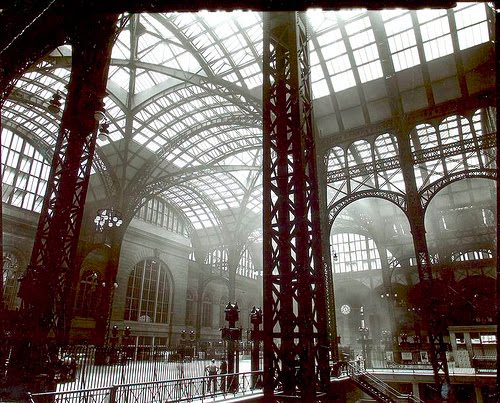
Penn Station, 1935, Berenice Abbott

Manhattan Newsstand, Berenice Abbott, 1935

Eugene Atget, b. 1857 - d. 1927, photo taken by Berenice Abbott in 1927

Berenice Abbott, b. 1898 - d. 1991, American Photographer

Great Crystal Palace, England, 1851

trompe l'oeil
Pronunciation: trump loy

The Oculus, 1473, Fresco, located in Northern Italy

Holy Trinity, 1425, Fresco, located in Florence, approx. 25 feet tall and 10 feet wide.
Art History Flashcards


Current day example of trompe l'oeil